Why it survived
In 1878 the people of the Kolašin region gave the forest to Prince Nikola I as a gift. He declared it protected — a hunting reserve, but protected — and it stayed that way. That makes it one of the oldest protected areas in Europe, older than most national parks anywhere.
It became a national park in 1952. The core is virgin forest: never logged, never planted, with dead trees left where they fall because that is what a forest does when nobody tidies it.
- Around 86 tree species and over 200 kinds of plant
- Some spruce and fir over 500 years old and 45 metres tall
- Trees up to 1.5 metres in diameter
- Six glacial lakes in the park, of which Biogradsko is the largest
The lake
Biogradsko jezero sits at 1,094 metres, ringed by forest that comes right down to the water. A flat path runs all the way round it: 3.5 kilometres, about an hour at a slow pace, no climbing, suitable for anyone who can walk on gravel.
In the shoulder seasons it is glassy and reflects the whole forest, which is the photograph. In August there are rowing boats on it and families around the shore, and it is still quiet by the standards of anywhere on the coast.
| Park entry | €3 – €5 per person |
| Circuit of the lake | 3.5 km, about 1 h, flat |
| Rowing boat hire | €8 – €12 an hour |
| From Kolašin | 20 min by car |
| From Podgorica | 1 h 30 |
| Season | Road open roughly May – October |
Beyond the lake
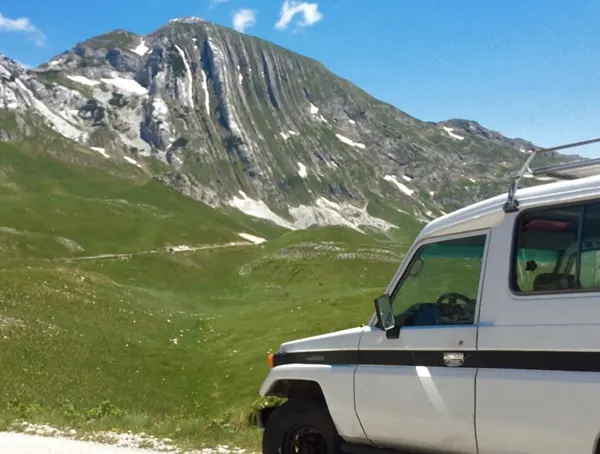
Most visitors do the circuit and leave, which means the rest of the park is empty. Marked paths climb into the Bjelasica massif towards Crna glava at 2,139 metres — four to six hours return, above the treeline for the second half, with the Komovi and Durmitor visible from the top.
There are also katuns on the high pastures — summer shepherd settlements where families still bring cattle up in June and take them down in September. Some sell milk, cheese and kajmak to walkers who pass.
Where it fits
Twenty minutes from Kolašin, which is on the railway from Podgorica — this is the one serious piece of Montenegrin wilderness that is genuinely reachable without a car. Train to Kolašin, taxi to the park, walk the lake, taxi back.
It also sits on the road between Podgorica and Durmitor, which makes it a natural break on that drive rather than a detour.
Sleeping there
There are wooden cabins and a campsite by the lake, run by the park. Basic, cheap, and booked out in August. The advantage of staying is the hour after the day visitors leave, when the lake goes still and the forest gets loud.