The honest summary
Accessibility legislation exists and enforcement is patchy. Newer buildings are usually compliant. Old towns are medieval and were not built with this in mind. Pavements in towns often lack dropped kerbs, and cars park on them.
That said, the coast has more flat ground than people expect, and the two things visitors most want — the sea and the bay — are among the more manageable parts.
Place by place
| Where | Realistic? |
|---|---|
| Kotor old town | Yes — it is flat inside the walls, cobbled but level. The walls are not. |
| Kotor to Dobrota promenade | Yes — long, flat, paved |
| Perast | Partly — one flat street, but steep access from the car park |
| Budva old town | Partly — flat inside, narrow, busy |
| Budva promenade | Yes — flat and wide |
| Herceg Novi | No — the town is built on stairs |
| Tivat and Porto Montenegro | Yes — modern, level, ramps throughout |
| Cetinje | Mostly — flat town, museums variable |
| Stari Bar | No — a ruin on a rock |
| Ostrog upper monastery | No |
| Njegoš mausoleum | No — 461 steps, no lift |
| Black Lake, Durmitor | Partly — the circuit is flat gravel, the approach has a slope |
Beaches
Most Montenegrin beaches are pebble with no access matting, which makes them hard. Two exceptions are worth naming:
- Slovenska plaža, Budva — some sections have ramped access and level promenade behind
- Velika Plaža, Ulcinj — sand, very gradual entry, and some concessions have matting
- Hotel beaches in Tivat and Bečići are generally the most equipped, and several allow day access
The concrete swimming platforms in the Bay of Kotor are worth knowing about — level, with ladders into deep water, no sand or pebble to cross. For a swimmer who can transfer, they are easier than any beach.
Transport
- Podgorica and Tivat airports have assistance; request it with the airline in advance
- Intercity buses are largely not accessible — steps, no lift, luggage hold storage
- The train Podgorica–Kolašin–Bijelo Polje has some accessible carriages, though provision varies
- Adapted taxis and transfers exist in Podgorica, Budva and Tivat but must be booked ahead
- Hire cars with hand controls need weeks of notice
Accommodation
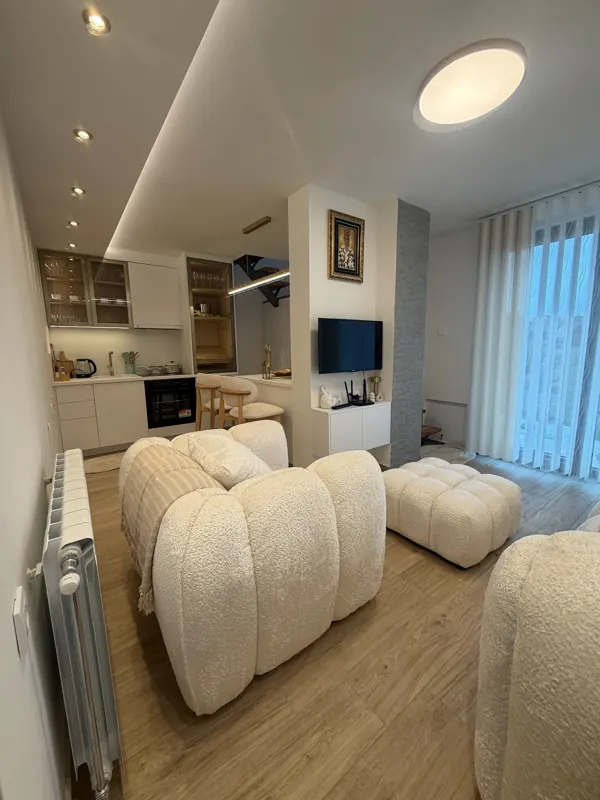
Larger hotels in Budva, Bečići and Tivat have adapted rooms. Private apartments — which are the bulk of the stock — very often do not, and "ground floor" in a listing frequently means up six steps from the street.
Ask for photographs of the entrance, not just the room. This is the single most useful thing to do before booking, and hosts here answer messages quickly.
A trip that works
Base in Tivat or Bečići — modern, level, adapted rooms. Day trips to Kotor old town, the Dobrota promenade, Porto Montenegro and a boat on the bay, which is one of the more accessible ways to see Boka since you board at a quay rather than a beach.
Leave the mountains, the walls and the monasteries for another kind of trip. That is a real loss and it is still a good week.